» Nous invitons avec insistance toutes les personnes de bonne volonté de penser et d’agir dans le bien de l’intérêt public et de celui de la Terre, non dans celui de l’intérêt des compagnies des industries fossiles. Nous reconnaissons comme un signe plein d’espérance le fait que de nombreuses communautés à travers les USA ont décidé d’agir pour protéger l’eau, les écosystèmes et la Terre. Le conseil municipal de Pittsburgh n’a pas seulement interdit l’usage de la fracturation hydraulique dans son secteur, mais il a aussi émis une nouvelle loi disant : « Les communautés naturelles et les écosystèmes, incluant (sans être exhaustif) les zones humides, les rivières et les fleuves, les réserves aquifères
et les autres systèmes naturels hydrologiques, ont un droit inaliénable et fondamental d’exister et de s’épanouir naturellement dans la ville de Pittsburgh. Les citoyens de la ville doivent avoir les moyens de protéger ces droits, au nom de ces communautés naturelles et de ces écosystèmes.
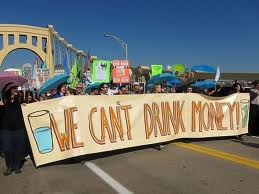
L’extrait ci-dessus vient d’une déclaration faite en mai dernier par l’association des « Religieuses pour l’eau » (ROW) réunissant des religieuses catholiques américaines qui réagissent notamment à la politique désastreuse en cours dans ce pays, autour des techniques de fracturation hydraulique et autres projets épuisant les ressources en eau.
Les responsables de congrégation qui sont à l’origine de l’association ROW sont : Elsie Bernauer, soeur dominicaine, Caldwell; Mary Bilderback, soeur de la Miséricorde ; Margaret Ellen Flannelly, soeur du sacré coeur de Marie ; Mary Ann Garisto, soeur de la Charité, à New York ; Suzanne Golas, soeur de saint Joseph de la Paix ; Mary Beth Hamm, soeur de Saint Joseph à Philadelphie ; Betty Kane, soeur de Saint François à Philadelphie ; Sandra Lyons, soeur franciscaine bernardine ; Didi Madden, soeur de Saint Dominique à Blauvelt ; Mary Morley, soeur de la Charité de sainte Elisabeth
A quand des congrégations françaises ou autres pour rejoindre ROW ?
Source : ncronline
Texte dans son intégralité (en anglais)
We believe that the endorsement of President Barack Obama and the other major presidential candidates for hydraulic fracturing, or fracking, a process used to drill for natural gas, is a shortsighted energy plan. As recently seen in Colorado at the premier auction for unallocated water, the top bidders were companies that provide water to well sites for fracking, not the farmers who were once the exclusive bidders. Water is crucial to all life, and squandering it for hydraulic fracturing puts water at risk.
Water is life. Water has been called the arterial system of Earth, sustaining all forms of life as it flows through every system and species. Unfortunately, more people die from the lack of safe water every day than from any war or disease plaguing our planet. Furthermore, more children die every day from not having access to safe, clean water than from any disease or accident. The protection of and respect for water should be our No. 1 concern during this era of a global water crisis.
Our water and our ecosystems have been under threat for years as our thirst for energy and the mining of natural resources has grown exponentially with the rise of industrialization. Many of these mining practices have been reckless in their consideration of the importance of clean, safe water for all of life. As we affect all of life’s access to clean, safe water through our destructive actions in these mining excavations, we are also recklessly dumping, spilling and mixing toxic chemicals into water. This is no more apparent than in the process of hydraulic fracturing in the United States.
From a life perspective, the hydraulic fracturing process’ threat to water is alarming. Hydraulic fracturing is an extremely water-intensive process that involves a drilling technique that mixes nearly 600 chemicals with sand and water, then blasts underground rock with up to 8 million gallons of this hydraulic fracturing fluid. The Safe Drinking Water Act in the U.S. Energy Policy Act of 2005 specifically exempted companies from having to disclose the chemicals that they mix with water in the hydraulic fracturing process. In 2010, the U.S. Environmental Protection Agency estimated that 70 billion to 140 billion gallons of water are used to fracture 35,000 wells in the United States a year. This estimate of water withdrawal is equivalent to the annual water consumption of 40 to 80 cities, each with a population of 50,000. Now in 34 states, hydraulic fracturing is spreading exponentially across the United States. Recent scientific studies have conclusively shown the detrimental effect hydraulic fracturing has on water, including studies from the EPA, Duke University and Cornell University.
Even before the recent scientific studies on the hydraulic fracturing process and its adverse effects on water, for years enough scientific studies have existed that have overwhelmingly proven and concluded that when you mix toxic chemicals with water and put them in the ground or in watersheds, rivers or streams, it is extremely damaging to human health and ecosystems.
We are ethically and morally outraged by the gas industry and by the actions of many elected officials for having pushed the burden of proof of these facts onto the American public, after the hydraulic fracturing process has entered and industrialized residential and farming communities and has polluted the water systems with toxic chemicals. The process of hydraulic fracturing currently has a confirmed track record across the United States of leaks, spills, dumping, blowouts and seismic activity, coupled with the inability to process the toxic wastewater. The hydraulic fracturing process is not clean, nor is it safe.
The amount of water in the hydrological cycle on Earth is finite; there is no more water here than there was 2,000 years ago. Also, one-third of the U.S. is currently suffering from drought conditions. We need to defend and protect water more intensely than we currently are. Recently, we have seen legislation after legislation introduced that weakens regulations for clean, safe water and ecosystems, and we find this recent turn in public policy completely unacceptable.
We urge all people of goodwill to think and act in the public interest and that of Earth, not in the interest of fossil fuel corporations. We find great hope in the actions of many communities throughout the United States that are rising up to protect water, ecosystems, nature and Earth. The City Council of Pittsburgh not only prohibited hydraulic fracturing within the city, but they also added this to the new law: “Natural communities and ecosystems, including, but not limited to, wetlands, streams, rivers, aquifers, and other water systems, possess inalienable and fundamental rights to exist and flourish within the City of Pittsburgh. Residents of the City shall possess legal standing to enforce those rights on behalf of those natural communities and ecosystems.”
Religious on Water’s hope is that you join the mounting grass-roots movement to ban fracking and that you join us in advocating and acting for the rights of water, ecosystems, people, nature and Earth.
 Églises & Écologies